
Skip to Content

Transit Cooperative Research Program Publications

TCRP Publications

Filters:
440 results
TCRP Publication

Legal Issues Concerning Transit Agency Use of Electronic Customer Data

LRD-48
February 18, 2026
This report explores the advantages, disadvantages, risks, and benefits for transit agencies moving to electronic, cloudbased, and other computerized systems for fare purchases and for communicating with customers. “Smart” fare cards are now commonplace, and private businesses and transit agencies are using or planning to use smartphones, smart cards and credit cards, and other systems to obtain payment, location, and other personal data from customers.The digest updates TCRP LRD 14: Privacy Issues in Public Transportation (2000) and TCRP LRD 25: Privacy Issues with the Use of Smart Cards (/2008 ) and covers additional dimensions of collection and use of personal information using new technologies developed since those studies. Appendix A-D are available online only at http://www.trb.org/Publications/Blurbs/175848.aspx
TCRP Publication

Multiagency Electronic Payment Fare Systems

S-125
February 18, 2026
> View webinar for this report This report describes the current practice, challenges, and benefits of utilizing electronic fare payment systems (EFPS), such as smart cards. The synthesis reviews current systems and identifies their major challenges and benefits; describes the use of electronic fare systems in multimodal, multiagency environments; and reviews next-generation approaches through existing implementation case examples.
TCRP Publication

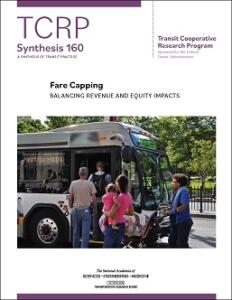
Fare Capping: Balancing Revenue and Equity Impacts

S-160
February 18, 2026
Transit agencies in the United States are beginning to experiment with fare caps to ensure that passengers who pay for single rides do not pay more than multiple-ride passes included in their fare structure. This report includes a review of the literature; a survey of 35 North American transit agencies that have recently considered implementing, are in the planning stages of implementing, or have implemented fare capping; and detailed case examples for five transit agencies that provide greater insight into the motivations, program designs, implementations, and lessons learned.
TCRP Publication

Multimodal Fare Payment Integration

S-144
February 18, 2026
Nearly all transit agencies are seeing potential benefits to multimodal payment convergence. However, many agencies find that implementing necessary upgrades is cost-prohibitive, which is the biggest barrier to full adoption. This report documents current practices and experiences of transit agencies dealing with the complexities of multimodal fare payment convergence. It also provides background and an overview of the program, status of each of TCRP’s projects, and a summary of some of the program’s accomplishments for the year.
TCRP Publication

Planning and Operations Initiatives to Support Nighttime Transit Ridership, from TRB’s Transit Cooperative Research Program

S-181
September 30, 2025
The COVID-19 pandemic-induced shift toward remote and hybrid work arrangements significantly impacted peak hour transit ridership across the United States; however, offpeak ridership exhibited greater resilience. As a result, many transit agencies began reevaluating their service strategies, placing greater emphasis on nighttime service enhancements to better serve emerging travel patterns and support those who rely on transit outside conventional work hours. This report documents current practices undertaken by transit agencies to support nighttime transit ridership and focuses on how transit agencies prioritize service improvements to support nighttime transit demand and address the needs of essential workers. It includes a survey of 25 transit agencies plus five case examples that examine strategies related to safety, operations, resource allocation, ridership trends, and partnerships.
TCRP Publication

Resilient Zero-Emission Transit Bus Fleets: A Guide

R-256
September 10, 2025
For transit operators with zero-emission transit buses (ZEB) in their fleets, the primary concern is whether the vehicles can meet the agency’s service requirements for both regularly scheduled service and for unscheduled service to address local or regional events and emergencies. This concern applies both at the individual route and fleet levels. This report provides a framework for transit agencies to update their resilience plans to operate ZEB fleets. It also offers a roadmap for transit agencies to integrate their existing zero-emission vehicle (ZEV) transition strategies into broader resilience planning efforts.
TCRP Publication

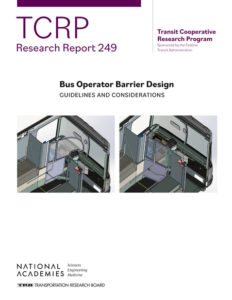
Bus Operator Barrier Design: Guidelines and Considerations

R-249
August 28, 2024
The nation was reminded of the importance of security barriers for transit bus operators by the fatal attack on a Tampa, Florida bus operator in 2019. The need for security barriers was reinforced by a serious attack on another operator for that same system later that year. While these are two extreme examples, they are likely not unique, as many assaults against transit workers have been underreported in the past. Another important but more pernicious risk to bus operator health is viral and bacterial infection. This report provides information and guidance for North American public transportation agencies, standards committees, and government and non-government policymaking organizations on designing, procuring, and installing bus operator barriers to prioritize the health and safety of essential operators and the public they serve.
TCRP Publication

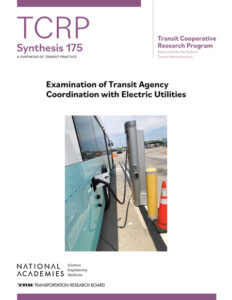
Examination of Transit Agency Coordination with Electric Utilities

S-175
July 22, 2024
Public transit agencies across the United States are transitioning conventional bus fleets to battery electric buses (BEBs). This transition requires large investments in charging infrastructure as well as new demands on the power grid, which provides opportunities for partnership with electric utilities to upgrade grid supply and energy loads, and also to reduce costs during peak load. This report provides practitioners and operational staff at public transit bus agencies and electric utilities with the state of current practices by agencies and utilities that are collaborating on BEB planning and deployments.
TCRP Publication

Bus Operator Workforce Management: Practitioner’s Guide

R-240
August 23, 2023
As of 2020, nearly 50 percent of the bus-operator workforce was over 55. Evidence indicates that many younger job seekers are often not aware of the potential career opportunities and employee benefits that are available at transit agencies. This report provides recommendations and resources enabling transit agencies to better assess, plan, and implement their operator workforce management programs.
TCRP Publication

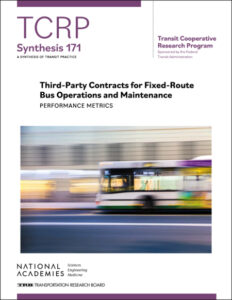
Third-Party Contracts for Fixed-Route Bus Operations and Maintenance: Performance Metrics

S-171
June 7, 2023
Transit agencies can provide fixed-route bus transit services through direct operation, contracting out to a third party, or a combination of both. Contracting out can be done to another transit agency or a private firm, and may include specific modes, routes, or garages. The quality and cost efficiency of outsourced service depend on local, contractual, and managerial factors. This report focuses on the performance metrics used in contracts for fixed-route bus operations and maintenance, extending the 2018 findings of TCRP Synthesis 136: Contracting Fixed-Route Bus Transit Service.