
Skip to Content

Transit Cooperative Research Program Publications

TCRP Publications

Filters:
446 results
TCRP Publication

Addressing Travel Needs of Women and Families on Public Transportation

R-265
July 23, 2026
Many women’s travel experiences relate directly to their disproportionate share of caregiving responsibilities. Travelers supervising dependents are more likely to need access to multiple destinations and may have more belongings in tow. Because dependents are unlikely to be commuting adults, travel during off-peak hours is more common, and paying multiple fares can increase the financial burden. Additionally, safety is a greater concern for women, both when they are traveling alone and when they are traveling with dependents, especially children. This report presents a set of practical tools to help transit agencies better understand their riders, use existing data more effectively, assess how well they are serving women and families, build internal support for these efforts, and identify service planning, vehicle, and station design strategies that benefit women and families. The eight tools are organized into three stages: Understand Your Riders, Build Internal Capacity, and Deploy Your Tactics.
TCRP Publication

Transit Agency Customer Experience Programs

S-187
July 16, 2026
In recent years, the public transit industry has seen a significant trend toward establishing formal Customer Experience (CX) programs, with over 60 U.S. transit agencies creating programs to better understand rider needs, instill a customer-first approach to their services, and build ridership and community support. However, the rapid adoption of these programs has occurred without industry-wide standards, leading to a wide variety of organizational models and approaches.

This report identifies emerging practices within transit agency CX programs across key themes, including program design, organizational structure, and performance measurement. In addition to results from an industry scan and survey, the report includes five case examples and highlights how CX programs are evolving within the transit industry, becoming a distinct professional specialization that increasingly relies on integrated data, performance measurement, and multidisciplinary collaboration. The report addresses the importance of strategic planning, investment, and the use of an “Influence Model” to guide CX initiatives. It also finds that CX programs are delivering measurable improvements for riders, and it identifies gaps and opportunities for future research to strengthen program effectiveness and advance the field.
TCRP Publication

Transit Capacity and Quality of Service Manual, 4th edition

R-262
June 22, 2026
Throughout its more than 25-year history, the Transit Capacity and Quality of Service Manual (TCQSM) has compiled the state of the practice based on peer-reviewed research published by the Transportation Research Board and others. The TCQSM provides transportation practitioners of varying levels of experience and responsibility information, techniques, and resources to support the planning, design, and operation of transit services, facilities, and systems. While the TCQSM’s methods represent the best available knowledge at the time of publication, they do not establish policies regarding desirable or appropriate levels of quality of service or capacity for transit services, facilities, or systems. This report includes updated statistics, transit agency application examples, and photographs. The manual incorporates emerging mobility options such as microtransit and low-speed automated vehicles, with expanded coverage of widely adopted technologies such as bus and ferry electrification. This edition updates key concepts related to modes and services, operations, and quality of service. Additional updates address topics including quality of service measures and applications, bus transit, demand-responsive transit, rail transit, ferry transit, and transit stops and stations.
TCRP Publication

Addressing Travel Needs of Women and Families on Public Transportation

R-265
June 22, 2026
Many women’s travel experiences relate directly to their disproportionate share of caregiving responsibilities. Travelers supervising dependents are more likely to need access to multiple destinations and may have more belongings in tow. Because dependents are unlikely to be commuting adults, travel during off-peak hours is more common, and paying multiple fares can increase the financial burden. Additionally, safety is a greater concern for women, both when they are traveling alone and when they are traveling with dependents, especially children. This report presents a set of practical tools to help transit agencies better understand their riders, use existing data more effectively, assess how well they are serving women and families, build internal support for these efforts, and identify service planning, vehicle, and station design strategies that benefit women and families. The eight tools are organized into three stages: Understand Your Riders, Build Internal Capacity, and Deploy Your Tactics.
TCRP Publication

Red-Tinted Bus Lane Experience

S-188
June 17, 2026
Red-tinted bus lanes are defined as lanes featuring red-colored pavement intended to enhance the visibility of locations, station stops, or travel lanes reserved exclusively for public transit vehicles or multimodal facilities where public transit is the primary mode. Although red-tinted bus lanes have been implemented in several cities, there is relatively limited documentation on their impacts, operational challenges, and other information valuable to agencies interested in implementing them. This report documents the current state of practice for the implementation and performance of red-tinted bus lanes in North America. The report addresses topics such as planning, design, and implementation; materials; operations and enforcement; and system impacts. It also provides guidance and lessons learned from agencies that have implemented and operate red-tinted bus lanes.
TCRP Publication

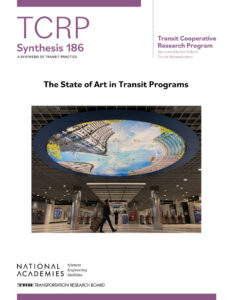
The State of Art in Transit Programs

TCRP Synthesis 186
March 30, 2026
Public art is used in public spaces to add a sense of safety, belonging, and collective ownership and is commonly displayed at transit facilities and on vehicles across the United States and Canada. However, there is limited consolidated information on how art in transit programs are organized and funded. This report documents the use of art in public transit systems throughout the United States and Canada. The synthesis includes information on historical and current art in transit programs and describes how agencies develop, implement, and manage the programs. For the purposes of this report, an art in transit program is defined broadly as any initiative to integrate art into a transit system, whether established or ad hoc. Art is also defined broadly as anything created by an artist, including temporary works and performance art, but excluding advertising campaigns.
TCRP Publication

Planning and Operations Initiatives to Support Nighttime Transit Ridership, from TRB’s Transit Cooperative Research Program

S-181
September 30, 2025
The COVID-19 pandemic-induced shift toward remote and hybrid work arrangements significantly impacted peak hour transit ridership across the United States; however, offpeak ridership exhibited greater resilience. As a result, many transit agencies began reevaluating their service strategies, placing greater emphasis on nighttime service enhancements to better serve emerging travel patterns and support those who rely on transit outside conventional work hours. This report documents current practices undertaken by transit agencies to support nighttime transit ridership and focuses on how transit agencies prioritize service improvements to support nighttime transit demand and address the needs of essential workers. It includes a survey of 25 transit agencies plus five case examples that examine strategies related to safety, operations, resource allocation, ridership trends, and partnerships.
TCRP Publication

Resilient Zero-Emission Transit Bus Fleets: A Guide

R-256
September 10, 2025
For transit operators with zero-emission transit buses (ZEB) in their fleets, the primary concern is whether the vehicles can meet the agency’s service requirements for both regularly scheduled service and for unscheduled service to address local or regional events and emergencies. This concern applies both at the individual route and fleet levels. This report provides a framework for transit agencies to update their resilience plans to operate ZEB fleets. It also offers a roadmap for transit agencies to integrate their existing zero-emission vehicle (ZEV) transition strategies into broader resilience planning efforts.
TCRP Publication

Bus Operator Barrier Design: Guidelines and Considerations

R-249
August 28, 2024
The nation was reminded of the importance of security barriers for transit bus operators by the fatal attack on a Tampa, Florida bus operator in 2019. The need for security barriers was reinforced by a serious attack on another operator for that same system later that year. While these are two extreme examples, they are likely not unique, as many assaults against transit workers have been underreported in the past. Another important but more pernicious risk to bus operator health is viral and bacterial infection. This report provides information and guidance for North American public transportation agencies, standards committees, and government and non-government policymaking organizations on designing, procuring, and installing bus operator barriers to prioritize the health and safety of essential operators and the public they serve.
TCRP Publication

Examination of Transit Agency Coordination with Electric Utilities

S-175
July 22, 2024
Public transit agencies across the United States are transitioning conventional bus fleets to battery electric buses (BEBs). This transition requires large investments in charging infrastructure as well as new demands on the power grid, which provides opportunities for partnership with electric utilities to upgrade grid supply and energy loads, and also to reduce costs during peak load. This report provides practitioners and operational staff at public transit bus agencies and electric utilities with the state of current practices by agencies and utilities that are collaborating on BEB planning and deployments.