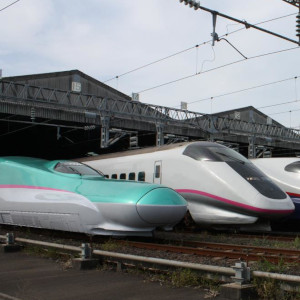
The Translohr, a new generation rubber tire
electric transit system, recently began demonstration runs on the 12.5-kilometer Trans Val
de Marne Bus Rapid Transit corridor operated by APTA member Regie Autonome des Transports
Parisiens, the public transit authority in Paris.
One of three novel medium-size guided transit systems, the Translohr, turned out by
Frances Lohr Industrie takes its place in sequential demonstrations on the Paris BRT
corridor along with Bombardier's Guided Light Transit and the Irisbus Civis vehicle. The
Trans Val de Marne BRT corridor is being made available for tests of the advanced hybrid
and rubber tire transit systems in limited revenue service to allow teams from French
cities in search of future medium capacity systems to see competitors' vehicles on a
"level playing field," according to Guy Bourgeois, the RATP project
administrator.
The TVR dual mode guided vehicle was operated on the corridor for about two years,
carrying 240,000 passengers a total of 300,000 km, and receiving visits from 160
delegations. The demonstration of the tramway-type modular Translohr began in December
2000 and is expected to run through 2001, to be succeeded by the optically guided dual
mode Civis next year.
Three French cities and suburban jurisdictions in the Ile de France region surrounding
Paris have opted thus far for the GLT, while Translohr is in the bidding stage. Civis has
already been selected by several French communities and will be on display in Las Vegas
during the APTA Annual Meeting and EXPO in September 2002,with the first production
vehicle due to arrive for service in Las Vegas in May 2003.
A consortium of more than two dozen public and private partners, most of them French,
are funding the combined demonstrations to allow elected officials and transit planners to
make appropriate choices for their respective cities.
The modular, bi-direction Translohr now in operation on the Val de Marne Busway, guided
along a shallow central rail, varies in length from 18 to 39 meters; it can carry from
2,000 to 5,000 passengers per hour and direction, depending on the number of articulated
modules chosen. It can go off line under its own battery power to return to the depot or
negotiate wireless stretches or tunnels. The manufacturer also states that the vehicle is
low floor throughout, has a narrow turning circle, can negotiate gradients up to 13
percent, and costs half as much to build than a conventional tramway.
The RATP is promoting a Europe-wide research project to compare and bench, mark the new
rubber-tired, bi-modal guided systems to recommend vehicle safety standards. A total of 24
partners in five countriesFrance, Italy, Spain, Sweeden, and the United
Kingdom-have signed up.
Return To International Focus
Some of these pages may include links to documents in the Adobe PDF format. Please download the Adobe PDF reader if you have not already done so.