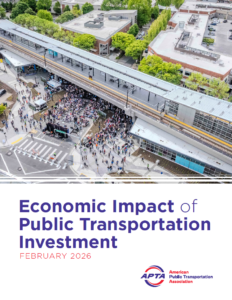
Economic Impact of Public Transportation Investment
Every $1 billion invested in public transportation generates $5 billion in long-term economic value and supports tens of thousands of jobs nationwide. These findings provide clear evidence that sustained investment in public transit and passenger rail delivers significant returns for workers, communities, taxpayers, and the U.S. economy. This new analysis finds that public transportation has a significant impact on the nation’s economic productivity. Investment in transit can yield 41,400 jobs per $1 billion invested, as well as supporting $3.1 billion in worker income and $251 million in Federal, State, and local tax revenue.

My Economic Impact Tool
APTA members can now access a powerful new tool for making the case for public transportation. The My Economic Impact tool uses your agency’s budget data to calculate the economic impact of your transit service.
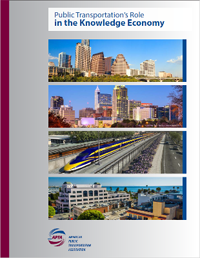
Public Transportation’s Role in the Knowledge Economy
Look at your community as a business. This groundbreaking study shows that planned public transportation investments will yield a 2 to 1 return while helping to generate income for local businesses, its workers and their neighborhoods. In fact, this investment will yield more than $174 billion in business sales in the three cites examined. Our study authors examined the emerging tech sectors in Silicon Beach, CA; Austin, TX; and Durham, NC and looked at public transportation’s emerging role in enhancing access to employees and promoting critical entrepreneurial infrastructure.
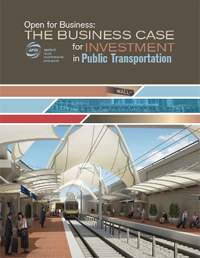
The Business Case for Investment in Public Transportation
Mobility in the United States is undergoing an evolution, driving new partnerships and challenging the traditional boundary between public and private realms. In fact, much of the innovation in transportation is coming from private sector, venture capital-backed support of smarter cities through technology. Though viewed as a primarily public-sector function, public transportation is proving to be the backbone of the multimodal, on-demand economy that private sector innovation is driving today.
The Role of Transit in Support of High Growth Business Clusters in the U.S.
This study addresses issues of business productivity, market access and transit service for America’s Innovation Districts. The study draws on eight high-growth knowledge-oriented business clusters and their transportation conditions in six US cities to provide an estimate of the total national income and employment consequences of congestion and how investment in public transportation maintain competitiveness.
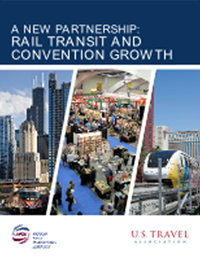
A New Partnership: Rail Transit and Convention Growth
This joint report produced with the U.S. Travel Association examines how cities with rail stations connected directly to airport terminals can realize increases in hotel performance. The report compares six cities with direct rail access from their airport terminal to five cities without. The analysis found that from 2006-2013, hotels in the cities with direct rail access brought in 10.9% more revenue per room than hotels in those cities without.